Friday, September 29, 2023

TO MY FRIENDS IN SINGAPORE

  I want to give a special thanks to my friends in Singapore. I have had many, many visits to this blog from that country. If you are visiting from there, would you consider sending me an email at broblong@gmail.com and introduce yourself, or simply click "comment" at the bottom of the post and leave a short statement letting me know how you found my blog and how it has blessed you.

Thank you for reading. May the Lord bless you richly.


---Billy Long

Wednesday, December 15, 2021

ROB'S HEALING

Below is a testimony of a miraculous healing that many of my friends have heard me speak of many times over the years.  What a joy it was to reconnect with Rob in 2016, about 5 years ago. What a blessing it was to know that this high school kid, now an adult, is strong in his walk with the Lord and still sharing his wonderful testimony.  ---Billy Long


HIGH SCHOOL KIDS EXPERIENCE JESUS
In 1971 when Laurel and I were first married we were asked to speak at a youth retreat for a group of high school kids from a Baptist church in Tulsa, Oklahoma.. While I was sharing our testimony of our walk and experiences with the Lord, you could have heard a pin drop. It was as if Jesus was walking among us. His presence became more real each time I mentioned his name. A couple of the kids expressed a desire to know Him. Then a few more. Suddenly twenty of them were on their feet and praying with and for one another. The other twenty, along with the football players, remained seated and just gazed in wonder at what was happening.

ROB'S MIRACULOUS HEALING
Then a young man named Rob came up to me. He had both emphysema and asthma. His breathing was a loud wheezing and was so labored that it could be heard all over the room. He had a breathing machine with him, and his doctors had recommended that he not go to this retreat. But there he stood before me with a look of despair and desperation. I pulled him off to the side and said, “Rob, do you want to know Jesus?” He said, “Yes,” but then pointed to his chest to communicate the agony he was going through with his lungs.
I quoted Jesus' words about laying hands on the sick, and then I laid my hands on his head asking Jesus to touch him. Suddenly he fell back and began to shout, “I can breathe! I can breathe!” The Lord had instantly healed him of the emphysema and asthma. I then yelled out to the group, “Hey, everybody, God just healed Rob!” Immediately the other twenty kids rose up like a covey of quail. All forty kids were standing with arms uplifted to the Lord praising and thanking Him for the miracle. They all instantly gave their lives to the Lord and stood there weeping, laughing, and praising Him. God did a wonderful work in those young people.
Following the retreat, the youth pastor invited me to meet with the group a couple times and teach them about the Holy Spirit. This was my senior year at ORU, and when I graduated Laurel and I moved away and had no contact with Rob for 45 years. However, we often spoke of him and wondered where he was and how he was doing, and we often told the story of his healing.

A WONDERFUL REUNION!
Then about 5 years ago, to my great surprise and delight, I received the following message on Facebook. Here is how the exchange went:
ROB MITCHELL: "Can you remember a youth retreat in the summer of '71 in Oklahoma? Steve Stockley was the youth pastor from Oral Roberts University. Were you the guest speaker?"
BILLY LONG: "Rob, how could I forget that!!!! Such a wonderful retreat. Are you the Rob who was healed?"
ROB MITCHELL: "Wow! This is great! Do you remember praying for me? I was completely healed that day, forever changed my life, and the lives of many others. I pastored for 20 years, and told my testimony everywhere I went. I'm crying like a baby just thinking about it… So much to tell you. Will surely talk some more, I still think of you and Laurel often."

Rob and his wife have five wonderful on-fire Christian children, and they currently lead a ministry in the toughest part of Tulsa. What a wonderful and joyful blessing it was to me and Laurel to re-establish contact with Rob, and 45 years  (now 50 years later), to hear him confirm the healing that took place at that retreat, and to know that he has been serving and walking with the Lord faithfully all these years.
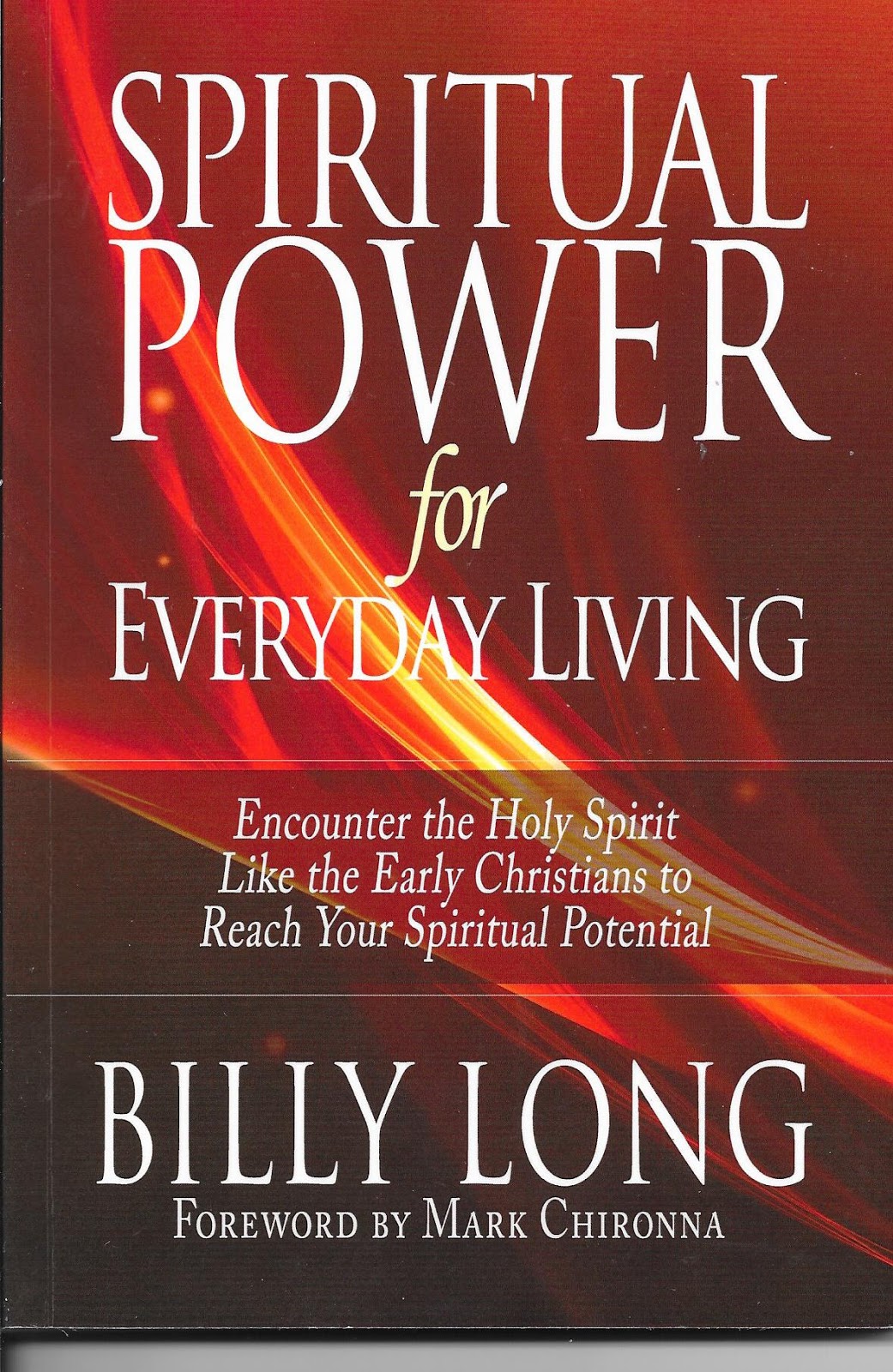
I am rejoicing and am so grateful to the Lord for allowing me to re-establish contact and hear the continuing story of his testimony. Rob's testimony is chapter 10 in my book, "Spiritual Power for Everyday Living."
Praise the Lord!
Billy Long

Tuesday, April 3, 2018

MY BOOK

If you are hungry to know more about how the Holy Spirit worked in the early Christian church, and if you are hungry to understand and experience the gifts of the Holy Spirit, you should order my book SPIRITUAL POWER FOR EVERYDAY LIVING. 
Go to my website at the link shown below to order your copy.

https://www.billylongministries.com/

The book clarifies many misconceptions and contains practical teaching with many examples and testimonies of the gifts at work. It is an excellent tool for teaching others about the manifestations of the Holy Spirit. ---Billy Long

Saturday, March 31, 2018

GREETINGS TO READERS FROM OTHER COUNTRIES

I am blessed that so many people from around the world have been reading my blog posts. I do appreciate your visits. 
There are many readers from South Korea, Europe, and other nations. Please send me an email and introduce yourself if you have enjoyed these posts. 

Write to me at broblong@gmail.com

Thanks so much. 
Billy Long

Monday, November 13, 2017

THE TYPICAL CHURCH CONTEXT THAT HINDERS SPIRITUAL GIFTS

This article describes why the typical church does not see more of the manifestations of the Holy Spirit at work. There are many personal reasons why individuals do not move in spiritual gifts, and we can list some of them in later posts. But this is written to describe the general church atmosphere that hinders the hungry and willing individual.  ----Billy Long

HOW SPIRIT-FILLED CHURCHES HINDER THE MANIFESTATIONS OF THE HOLY SPIRIT
Our expectation of the Lord’s active presence working among us is often disappointed because we tend to create an artificial context that does not allow people to “come forth” in their gifts reaching out to one another. 
The absence of relational interaction quenches the real moving of the Holy Spirit. The typical theater style spectator setting forces the congregation to sit as a passive audience focused on the stage up front as the Holy Spirit performs through the pastor, the worship team, and special gifted people. In this context most of the church subconsciously feel they must be super-stars or “special” to be able to “perform.” And so they sit passive and watch. Their active involvement is restricted to listening, congregational praise, prayer and song.  These are good, but  still missing is the individual's ability to actively participate and flow in the manifestations of the Holy Spirit.

Christians need fellowship where they can get to know one another and communicate personally within the group. The Holy Spirit works where people are able to open their hearts and share their concerns, their problems, and their gifts. Churches need to include gatherings in which there is no agenda or curriculum that hedges participants into some fixed path of discussion that precludes their creative sharing and involvement around issues that concern them and one another. The “living room” setting best facilitates this. Not just a small group, but one that has (as Watchman Nee says) an unofficial air and the marks of real life without the stiff formality of an official meeting that causes people to “act differently” than when they are relaxed and sharing their thoughts about real life issues in a comfortable setting.

One other problem that prevents Christians from learning to move in the gifts of the Holy Spirit is that we tend to compartmentalize the gifts by isolating and analyzing them out of context. There is a place for the classroom, but an academic approach that teaches principles and methods without face to face interaction in a relational setting will give people intellectual knowledge without first-hand experience.
We should not divorce learning spiritual gifts from people. We learn the gifts in the context of reaching out to others and experiencing the gifts as they work through us to touch people to impart what the gifts provide. We don’t learn to move in the Holy Spirit by simply learning a technique; we learn by reaching out to others with compassion.

PACTICAL STEPS TO MOVING IN THE HOLY SPIRIT


The first time I gave a word of knowledge in public was to a lady at a health club in Chapel Hill, NC.  I had never met her before. She was a doctor and her husband was an anesthesiologist. I stumbled around very awkwardly with my words, but managed to get them out. I told her the Lord had given me a word to encourage her. I then said, "You are married to your second husband. Your children are from your first marriage. There is tension in the home because your husband and the children do not get along.” She answered, “That’s right. My husband is rather immature." 
I then told her the Lord wanted to encourage her and help her and her family.
My presentation was not polished, but I was relieved to know the Lord had used me in spite of my uncertainty.
Every Christian who is filled with the Holy Spirit should be moving in the Holy Spirit to minister to others. My book, Spiritual Power for Everyday Living, gives definitions and examples of spiritual gifts and helps the reader to better understand them. I encourage everyone to go to www.billylongministries.com to order a copy.
The paragraphs below give some practical instruction in how to step out and see the Holy Spirit at work. You don’t have to be a spiritual superstar; you simply have to present yourself by using your feet, hands, and voice in very simple ways. If you follow the instructions below, you will be surprised at how the Holy Spirit will work through you as you open your heart to Him and others.      ---Billy Long

USE YOUR FEET
“How beautiful upon the mountains are the feet of him who brings good news…” Isaiah 52:7
“Now there was a certain disciple at Damascus named Ananias; and to him the Lord said in a vision, ‘Ananias.’ And he said, ‘Here I am, Lord.’ And the Lord said to him, ‘arise and go to the street called Straight, and inquire at the house of Judas for one called Saul of Tarsus, for behold he is praying.’”  Acts 9: 10-11

Make an Approach.
Go to someone. You may not know what to say or do. But don’t worry. You must make your approach. Sometimes it’s like diving for the first time---jump off the board and figure it out on the way down. It is okay if you “belly-flop” or hit the water at a bad angle. You learn by doing. Peter sunk in the water, but he was the only one who got out of the boat. Who is the Lord most pleased with…the ones safely in the boat, or the bold one struggling to walk on the water? Even sinking, he was ahead of the others.

“Arise and Go.”
When Jesus appeared to Ananias with instructions for him to minister to Saul of Tarsus, He told him to “Arise and go” (Acts 9: 10-16). Sometimes the first act of faith is to simply get out of the chair and walk over to someone who needs ministry. Sometimes we miss out on the presence and power of God among us because we remain at a physical distance.
In approaching Saul, Ananias had to overcome more fears than we face in our gatherings. He responded to the Lord’s bidding and went to Paul, and the power of God worked through him. We will never minister unless we actually go to the person and make an approach.  It may mean stepping across the room, going to someone’s chair, walking to the front of the room, going across the street, or even across town. The power and the substance of what God wants to give will be given to us as we arise and go. We show faith and courage in simply stepping out.

“A Certain Disciple”
God will use you. You don’t have to be someone special. Ananias was not an apostle or some eminent person. He was like most of us. The Bible simply calls him “a certain disciple.” A true disciple is one who learns, follows, and commits to growth and usefulness in his walk with the Lord. When the Lord spoke to Ananias, his response was “Here am I,” which is equivalent to “Yes, Lord.” The Lord is pleased when we say, “Yes.”

“For Behold He is Praying”
We should be encouraged by the fact that the Holy Spirit works on both ends of the transaction. While the Lord was prompting Ananias to arise and go to Saul, Saul himself was praying and waiting before the Lord. He needed the touch and healing that Ananias was bringing. If we could glimpse into the spiritual realm and really see the needs, hopes, concerns, cries, and agonies that lie beneath the surface, hidden inside the hearts of the people around us, if we only realized how much God in His love desires to speak to, touch, encourage, and bless His children and those with whom we come in contact every day, we would be more motivated to reach out boldly with confidence and faith.

Use Your Hands
Implications of the Touch
If you don’t think you’re spiritual enough to say anything or move in the gifts of the Holy Spirit, you can at least walk over and lay your hand on someone’s shoulder. A touch can say a lot. The laying on of hands can signify sympathy, love, and caring when Christians pray and minister to one another. Reaching out to touch someone when praying for him or her can be a powerful channel for the Holy Spirit. The physical touch on the arm, shoulder, or head seems to break down the “walls” and helps people to open their hearts to receive. The touch implies compassion in the one ministering and receptivity in the one being ministered to. And the Holy Spirit does His work.

A Means of Impartation
Our hands represent the hands of Jesus when we reach out in His name. In the New Testament the laying on of hands was not just a liturgical, ceremonial activity. It was, and still is, a means of impartation. The Lord intends that something substantial and real actually happens. In the New Testament the laying on of hands was a means of…
a.    … imparting blessing. Matthew 19: 13-15; Genesis 48:13-15.
b.    …imparting the Baptism in the Holy Spirit.  Acts 8:17; 19:6
c.    …imparting healing. Mark 16:18; Luke 4:40.
d.    …commissioning ministries. Acts 6:6; 13:3.
e.    …imparting spiritual gifts. 1 Timothy 4:14; 2 Timothy 1: 6; Rom 1:11.
f.      …releasing God’s purpose. Acts 9: 12-18.

An Instrument of the Holy Spirit
Your hand becomes an instrument of the Holy Spirit when you reach out in faith and compassion. Laying your hand on someone releases the flow of God’s power. The efficacy is in the touch. The woman who had been sick for twelve years said to herself, “If only I may touch His garment, I shall be made whole.” (Matthew 9: 21). Because of her faith, the power of God went into her body when she touched Jesus.

No matter where you are in your spiritual growth, you can always reach out and touch someone. You can allow your hand to be the instrument through which Jesus touches others, especially if you have been filled with the Holy Spirit.


USE YOUR VOICE
Then Moses said to the Lord, “O my Lord, I am not eloquent, neither before nor since You have spoken to your servant; but I am slow of speech and slow of tongue.”
So the Lord said, “Who has made man’s mouth....Have not I the Lord? Now therefore, go, and I will be with your mouth and teach you what you shall say.” −Exodus 4: 10-12

Speak up
The purpose of this segment is to encourage Christians to speak up in ministering to one another, especially in house groups and in one-to-one relationships. People are more likely to actively participate and interact with one another in a living room setting. Small groups, therefore, should be designed as a platform for openness and communication, a setting where people are at ease and comfortable enough to let down their walls, to listen, and to speak. We quench the Spirit when we are closed and silent. We allow the Holy Spirit to move when we remove the walls and open our hearts to one another. Churches need small groups that allow for relational interaction rather than always being centered around some agenda or a mini version of the large groups where people sit theater style listening to someone up front.

You don’t have to be a pastor to minister a word to others. The man Ananias whom Jesus sent to Saul was only a “certain disciple.” He held no ministerial office. A large portion of the church (except the apostles) was scattered abroad during time of Stephen’s persecution. They were not primarily preachers. They were Christians who had a testimony and went out “speaking” the word (Acts 11:19). The word “speaking” in this verse is not the Greek word for “preaching,” but simply the generic term “speaking.” The term implies individuals sharing their life and testimony in daily conversation with people they met every day in informal settings. They were willing to open their mouths and say something.

You don’t have to preach a sermon. You can share your testimony, tell someone what the Lord did for you or said to you. You can share the impression you received while listening or praying. As we interact with one another the Holy Spirit will use us in any of the following ways:
1.    Prayer. To simply walk over to someone and pray for them.
2.    Exhortation. To compassionately advise, encourage, or stir people to action.
3.    Prophecy. To speak a word from the Lord by inspiration of the Holy Spirit.
4.    A word of knowledge. To share a revelation of some fact or issue.
5.    A Word of faith. A confident word that brings God’s answer or stirs others to faith.
6.    A word of wisdom. A word given to help in a difficult situation or time of perplexity.
7.    A word of comfort or encouragement.
8.    An expression of love and care
9.    A simple word to let a person know you are there and that you care. (You don’t have to have all the answers. People often just need to know someone is standing with them.)  
10. Weeping over someone. Our tears are effective in touching the hearts of others.  

Our ministry to one another does not have to be thunderous or overwhelming. The power is in the still, small voice as we share the life of the Lord through humble and encouraging words or prayers. Even if we have little to offer, we must realize that the Lord will multiply our “bread” as we step out in faith and share it. He touches people with His love as we present ourselves to be instruments of His love.

What’s in the heart is what flows forth in our speech. The mouth functions properly when the heart is cultivated properly. The Christians who are most effective in ministry to others are those who have a genuine relationship with Jesus, who fellowship with Him in daily Bible reading and prayer, and who desire to reach out to others.
Therefore, when you approach someone who has requested prayer or ministry, you must remember that the Holy Spirit is with you and “the word is very near you, even in your mouth and in your heart.” You must simply step out in faith and share it.

"The Lord has given me the tongue of the learned, that I should know how to speak a word in season to him who is weary.”    Isaiah 50:4

If this article has helped you, you may want to consider ordering a copy of my book which gives very clear and practical teaching on the Baptism in the Holy Spirit, the manifestations and gifts of the Holy Spirit, and praying in tongues. This book is helpful to new believers and mature Christians alike.  Go to my website to order a copy. See link in first paragraph.  ----Billy Long

www.billylongministries.com


Thursday, April 27, 2017

Please Introduce Yourself

I am grateful for those of you who visit my blog. I am especially pleased to have so many visitors from South Korea. I am blessed that you have been reading my posts and have recommended them to your friends. I would be blessed if you would send me a message and introduce yourself, so that I may know my new friends from South Korea. My email address is broblong@gmail.com.  
Billy Long

Friday, November 25, 2016

You Can Now Order My Book

My book is now available. If you want a copy or multiple copies, you can go to my website and purchase the book.  Just click on this link:  https://billylongministries.com
You can also order the e-book at Amazon.com.    ---Billy Long

Tuesday, July 19, 2016

A Reunion with the kid who was healed 45 years ago

Below is a testimony of a miraculous healing that many of my friends have heard me speak of many times over the years.  What a joy it was to reconnect with Rob in 2016, about 5 years ago. What a blessing it was to know that this high school kid, now an adult, is strong in his walk with the Lord and still sharing his wonderful testimony.  ---Billy Long

HIGH SCHOOL KIDS EXPERIENCE JESUS
In 1971 when Laurel and I were first married we were asked to speak at a youth retreat for a group of high school kids from a Baptist church in Tulsa, Oklahoma.. While I was sharing our testimony of our walk and experiences with the Lord, you could have heard a pin drop. It was as if Jesus was walking among us. His presence became more real each time I mentioned his name. A couple of the kids expressed a desire to know Him. Then a few more. Suddenly twenty of them were on their feet and praying with and for one another. The other twenty, along with the football players, remained seated and just gazed in wonder at what was happening.

ROB'S MIRACULOUS HEALING
Then a young man named Rob came up to me. He had both emphysema and asthma. His breathing was a loud wheezing and was so labored that it could be heard all over the room. He had a breathing machine with him, and his doctors had recommended that he not go to this retreat. But there he stood before me with a look of despair and desperation. I pulled him off to the side and said, “Rob, do you want to know Jesus?” He said, “Yes,” but then pointed to his chest to communicate the agony he was going through with his lungs.
I quoted Jesus' words about laying hands on the sick, and then I laid my hands on his head asking Jesus to touch him. Suddenly he fell back and began to shout, “I can breathe! I can breathe!” The Lord had instantly healed him of the emphysema and asthma. I then yelled out to the group, “Hey, everybody, God just healed Rob!” Immediately the other twenty kids rose up like a covey of quail. All forty kids were standing with arms uplifted to the Lord praising and thanking Him for the miracle. They all instantly gave their lives to the Lord and stood there weeping, laughing, and praising Him. God did a wonderful work in those young people.
Following the retreat, the youth pastor invited me to meet with the group a couple times and teach them about the Holy Spirit. This was my senior year at ORU, and when I graduated Laurel and I moved away and had no contact with Rob for 45 years. However, we often spoke of him and wondered where he was and how he was doing, and we often told the story of his healing.

A WONDERFUL REUNION!
Then about 5 years ago, to my great surprise and delight, I received the following message on Facebook. Here is how the exchange went:
ROB MITCHELL: "Can you remember a youth retreat in the summer of '71 in Oklahoma? Steve Stockley was the youth pastor from Oral Roberts University. Were you the guest speaker?"
BILLY LONG: "Rob, how could I forget that!!!! Such a wonderful retreat. Are you the Rob who was healed?"
ROB MITCHELL: "Wow! This is great! Do you remember praying for me? I was completely healed that day, forever changed my life, and the lives of many others. I pastored for 20 years, and told my testimony everywhere I went. I'm crying like a baby just thinking about it… So much to tell you. Will surely talk some more, I still think of you and Laurel often."

Rob and his wife have five wonderful on-fire Christian children, and they currently lead a ministry in the toughest part of Tulsa. What a wonderful and joyful blessing it was to me and Laurel to re-establish contact with Rob, and 45 years  (now 50 years later), to hear him confirm the healing that took place at that retreat, and to know that he has been serving and walking with the Lord faithfully all these years.
I am rejoicing and am so grateful to the Lord for allowing me to re-establish contact and hear the continuing story of his testimony. Rob's testimony is chapter 10 in my book, "Spiritual Power for Everyday Living."
Praise the Lord!
Billy Long

Saturday, November 28, 2015

Scroll down to read earlier posts

I want to remind the reader that you have to scroll down to read earlier posts. The article posted below is the most recent in the series on prophetic ministry in the New Testament Church. Scroll down to read earlier posts that lay foundations and help the reader to better understand the topic.  At the very bottom of the page you can click "older posts" to go back even further and read the articles on Spiritual Gifts that preceded and serve as an introduction to this series.  ---Billy Long

Saturday, January 3, 2015

But if all prophesy, and an unbeliever or an uninformed person comes in, he is convinced by all...and thus the secrets of his heart are revealed; and so falling down on his face, he will worship God and report that God is truly among you.                  1 Corinthian 14: 24-25.

Thursday, January 1, 2015

Spiritual Gifts and Godly Character

This article continues our teaching on the subject of “Prophecy in the New Testament Church.” The emphasis in this post (and the next one) deals with very important aspects which are especially important for leadership to understand. ---Billy Long 

Spiritual Gifts and Godly Character  
And though I have the gift of prophecy, and understand all mysteries and all knowledge, and though I have all faith, so that I could remove mountains, but have not love, I am nothing.  1 Corinthians 13: 2

Knowledge puffs up, but love edifies.  1 Corinthians 8:1

His divine power has given to us all things that pertain to life and godliness, through the knowledge of Him who called us by glory and virtue.  2 Peter 1:3

Many will say to me in that day, “Lord, Lord, have we not prophesied in Your name, cast out demons in Your name, and done many wonders in Your name”? And I will declare to them, “I never knew you; depart from Me, you who practice lawlessness!”  Matthew 7: 22-23

Truth must be accompanied by compassion, godly character, and integrity. This principle applies to any aspect of our relationship to the Lord and His word, whether it be Bible study, preaching, personal counsel, exhortation, or prophecy.  Complications arise when carnal man (rather than the spiritual man) handles the word of God. The lack of compassion causes it to be used as a legalistic hammer to condemn and hurt people. The lack of character and holiness brings deception, mixture, and contamination. The lack of integrity causes men to “use” people and act with wrong and selfish motives.

When we think of spiritual gifts we think of God’s power. But God’s power must not be divorced from godly character and God’s holiness. Character and integrity are the things that prevent prophecy and the other gifts from being “flash” and glitter. Character is the foundation for the anointing and a ministry that has purity and durability. A person’s character can destroy what his gift builds. It is essentially character, not gifting, that determines whether or not we pass the tests of life.

Therefore, we seek to walk in God’s holiness as well as in His power. Power without holiness and character is empty and rings hollow. The world will scorn us if we walk in the power of God but fail in the holiness of God.  The holiness of God (right living, right motives, and moral purity) is what distinguishes us from the rest of the world. The devil can imitate our noise and our power, but he cannot reproduce holiness and godly character.
The devil’s counterfeit imitation of God’s power is seen in soulish mysticism, sorcery, witchcraft, the occult, and psychic phenomena.  His attempts at imitating holiness and character become legalism and bondage.

Godly character is something we as Christians must be careful to cultivate. Good people excelling at good things have to beware of pride. Immature and unlearned people must remain humble in order to learn and avoid the paths of error. People who experience the power and working of the Holy Spirit must especially guard their hearts to maintain integrity and pure motives.  There have  been men and women of God who moved in healing and power gifts who fell because they were deceived into thinking God was overlooking their sin.  Because the miracles continued, because God was still using them, they presumed to think God was giving them special dispensation to continue in their sin with impunity. The fact is the Holy Spirit will continue to use a person who is in disobedience and sin, at least for a season, while the Holy Spirit tries to draw him to repentance in the particular area of transgression.   However, eventually “the bottom will drop out” and the person will face the consequences of his un-repentant sin. Sometimes the problem may be an area of stubbornness, an area which grieves the Lord. Whether sin or childish stubbornness, eventually a person may face either judgment or discipline.

In this same vein of thought it should be noted that some very interesting (though not godly) people have prophesied. Balaam was a soothsayer who spoke some wonderful prophetic words over Israel, words which also prophesied of Jesus (Numbers 22-23). King Saul himself prophesied, even while trying find and kill David (1 Samuel 10:6, 10-12;  19:18-24). The high priest Caiaphus, while leading the plot to put Jesus to death, prophesied that one must die for the nation.  These examples (and maybe some you know personally) show us that the gifts and manifestations of the Holy Spirit operate by the mercy and grace of God, and that God will use imperfect vessels.
The imperfections may be related to ungodly character (like those discussed above) or to issues related to normal spiritual growth and character development experienced by all Christians. If the issues relate to sin and evil, we should repent and change. If the issues relate to the stumbles and imperfections of normal growth, we should recognize that mistakes are a part of growth, thank God for the disciplines of learning, and move forward rejoicing in the grace, mercy, and goodness of the Lord.

Don’t try to fulfill the prophecy yourself; let God do it.
Then the men of David said to him, “This is the day of which the Lord said to you, ‘Behold, I will deliver your enemy into your  hand, that you may do to him as it seems good to you.’” And David arose and secretly cut off a corner of Saul’s robe.  And he said to his men. “The Lord forbid that I should do this thing to my master, the Lord’s anointed, to stretch out my hand against him, seeing he is the anointed of the Lord.” 1Samuel 24: 4-5.
Abishai (acting on the same promise quoted by David’s men in the verse above) said to David, “God has delivered your enemy into your hand this day. Now therefore, please strike him at once with the spear, right to the earth.”  1 Samuel 26: 8
This principle applies to those who receive a prophetic word. We must allow God to fulfill His own words rather than our trying to do it ourselves. Waiting on God’s timing requires faith, patience, and godly character.

Abraham is the first example that comes to mind.  He was promised a son, but instead of waiting on God to fulfill this word, Abraham tried to do it on his own. He produced an Ishmael by his own flesh rather than waiting on Isaac the son of promise.

The prophetic word to David was that God would deliver his enemies into his hands. In the two verses quoted above, King Saul was on a campaign to find and kill David. In the first example, David was hiding in the recesses of a cave where Saul just happened to enter to “use the restroom.” In the second example, Saul was asleep in his camp. In both cases David could have killed Saul while he was in defenseless and vulnerable positions. In both cases David’s men encouraged him, based on a prophetic word, to kill Saul. They whispered “This is your chance to fulfill the prophecy. Saul is your enemy and you can kill him now!” David, however, knew in his heart that this was not the time or the manner. He would not enlist his own flesh or the devil’s methods to accomplish God’s purpose. He would wait for God’s hand, God’s timing, and God’s way.

A word from God not only encourages and strengthens us, but also, at times, tests us (Psalm105: 19). A word from God does not necessarily make life easier. Sometimes it precedes waiting, and it requires faith and patience (steadfast perseverance). In the words of an Old Testament prophet, “Though it tarry, you must wait for it.”

Keep a look-out for the next post as we continue our discussion on Prophesying, especially as it relates to leadership. —Billy Long

Monday, December 29, 2014

I want to remind the reader that you have to scroll down to read earlier posts. The article posted below is the most recent in the series on prophetic ministry in the New Testament Church. Scroll down to read earlier posts that lay foundations and help the reader to better understand the topic.  
At the very bottom of the page you can click "older posts" to go back even further and read the articles on Spiritual Gifts that preceded and serve as an introduction to this series.  ---Billy Long

A Healthy Context for Prophecy in the New Testament Church

Prophecy is supernatural, but it does not have to feel that way. The supernatural-ness is determined by context and timing as well as by content.
I remember on one occasion I was about to teach a Bible study to a group of about twenty or thirty young people, and was silently asking the Lord to confirm my direction for the teaching that night.
As the group was worshiping the Lord, one of the boys stood up. I knew he was about to share what he thought would be a prophetic word from the Lord. He said, “The Lord wants us to watch and pray.” He then paused and stood there silent for a minute hoping to add something more significant. But that was it. He had nothing else to say, and so he sat down feeling a little embarrassed and thinking he had failed.
I then stood up. “Our friend has just given a short, simple word telling us to watch and pray. He does not realize how the Lord has used him. He has not only shared a word to which we should all take heed, but also, without knowing it, he has given a word of confirmation to me. I was just now asking the Lord to confirm the teaching I am about to give. My text for tonight is Matthew 26: 41, ‘Watch and pray…’ My Bible was opened to that verse and my eyes were on those very words as our friend was saying ‘The Lord wants us to watch and pray.’”

You don’t have to act strange or take on a different personality.
In some cases a prophecy may be given directly from God syllable for syllable, word for word. In other cases God may inspire the concept, the idea, or the thought, but allow them, in their expression, to take on the flavor of the speaker.
The Spirit-filled Harvard professor very calmly walks up to someone and in a very dignified and stolid voice and says, “This is what the Lord is saying to you, Your canines will develop acariasis and become acaudal.”
A backwoods farmer then walks up to the same person and in a very emotional and energetic manner says, “Thus saith the Lord. Thy dogs-uh will become infested with ticks and lose their tails-uh.”
The fact is, these men said the same thing, but each one spoke out of his own personality and style. The Lord’s word was in the content while the style represented the individual vessel.

You can speak in a conversational tone.
“The spirits of the prophets are subject to the prophets.”  1 Corinthians 14: 32.
How do we expect people to act when they are being used by the Holy Spirit? A fellow once said to me, “My preacher is so anointed he pure foams at the mouth.” That is a strange one, and I am thankful that the Lord does not expect us to do that. So what style do we use in our presentation?
While there may be unusual and strange occurrences during great visitations of God’s presence, it is important for us to know that generally speaking we can move in the supernatural presence of the Holy Spirit in the normal conversational tone of everyday life. How else can we approach the average person in the world with the reality of Jesus Christ? The Holy Spirit’s work is not confined to a religious context. He can move in church or in any context of daily life as we interact with people.
We can be ourselves, we don’t have to act strange or change our voice. This is one of the keys to moving in the Holy Spirit on the job, in school, on the street, and out in the market-place. You don’t have to walk up to people and shout. You don’t have to say ‘’God-uh” or “yea, yea, thus saith the Lord.” You can be emotional or non-emotional. You can be enthusiastically zealous or you can be quiet and reserved. The key is to be genuine and real. The supernatural is not what you do, but rather what God Himself does. Sometimes God’s work is seen as obviously and patently supernatural. Other times it can be hidden and unnoticed because it is defined by the context and timing and may be significant only to those to whom it is directed.

A person moving in prophecy should not be passive.
“The spirits of the prophets are subject to the prophets.”  1 Corinthians 14: 32.
This verse deals with two problems: emotionalism and passivity. Emotions (such as joy and enthusiasm) are good, but emotionalism tends to be emotions posing as or substituting for the Holy Spirit, and generally tends to quench the Holy Spirit. Emotions represent our response to God’s presence. 
The verse also deals with the problem of passivity.  “The spirit of the prophet is subject to the prophet” means a person should not put his mind and thoughts in neutral waiting for “something” to take over.  Demonic counterfeits, the occult, and false religions work on the principle of passivity. We see it in meditation as practiced by eastern religions and in the demonic ceremonies of animistic cultures. Allowing your thoughts to go into neutral and your mind to be “blank” opens the door to demonic spirits, who take control. By contrast the Spirit of God works together with us while our faculties are at work and engaged. The Holy Spirit works through our spirits, and our spirits are subject to us. There are times when the Holy Spirit will move forcibly upon us (as in unusual revivals), but generally speaking He will be gentle and lead us rather than drive us. He requires our cooperation and our active involvement rather than a limp vessel with passive mind.

We Prophesy in part.
“For we know in part and we prophesy in part.”1 Corinthians 13: 9
“For now we see in a mirror dimly.” 1 Corinthians 13: 12
Paul reminds us that we are not infallible and our knowledge is limited. A person moving in prophecy will generally be given only a glimpse of the issues to which he speaks. We may not fully comprehend or understand the implications of the words we give.   

Prophecy should be judged
“Do not quench the Spirit. Do not despise prophecies. Test all things; hold fast what is good.” 1 Thessalonians 5: 19-21
“Let … prophets speak, and let the others judge.” 1 Corinthians 14: 29
Because we are human, we have to deal with the principle of mixture. We make mistakes. Within proven Christian fellowship our ministry and words should be pure and clearly from God. However, we sometimes let the imaginations of our own heart blend in with the word and create mixture. This produces the need to test and evaluate whether a word is from God or from man, or a mixture of both. 
The devil can also be the motivating source of a word or activity. This is why a prophetic word or any ministry must be evaluated by the written word of God and discerned by those who are spiritually mature.  
Prophecy usually confirms issues which a person has already been dealing with or considering. It should not give direction “out of the blue.” A person should not accept a word with which he does not indentify. He might reject it if he thinks it is wrong, or place it in his “pending file” to be evaluated again later. A person should not make a decision base on a prophetic word alone. He should have an inner witness or a confirmation from fellow Christians or spiritual leaders. Prophecy must be harmonious with and not contradict the Bible.
Prophecy, like preaching, does not replace the Bible nor does it stand on the same level as scripture. It must be judged or evaluated the same as a sermon or any other word of instruction or exhortation. The Bible is the written word of God and is the standard by which prophecy and all ministry, church doctrine, and practice should be judged (Galatians 1: 6-9; 2 Peter1:16-21; Act 17:11).   In testing prophecy or any other word of ministry, we consider the following: Is it harmonious with scripture? Does the recipient of the word identify with it and does he have an inner witness to the truth of the word? Are fellow Christians or spiritual leaders able to confirm the word? Does the word reflect the love and peace of Christ.

We should not force people to accept our words.
A person giving a prophetic word must allow the recipient freedom to test the word and to accept or reject it. We do not coerce a person to act beyond what he has grace to do. We do not force a person to receive our words. We allow him the freedom to reject the word and go his own way, even if it is to his judgment and God’s discipline.

We should prevent excesses and abuses that harm the reputation of the prophetic ministry.
You should not prophesy every time you get a thought or feeling.
You should not “prophesy” things you ought to communicate from yourself.  Don’t “prophesy” what should be given as an exhortation, or counsel, or personal input and your opinion.
Prophecy should not be used as a substitute for personal confrontation. Some people attribute to God what they themselves would like to say. They put the other person in the psychologically uncomfortable position of having to disagree with God. 
It is best not to prophesy in situations where there is conflict. People will not accept it. If it’s wrong, it is soulish or carnal and not spiritual. If it’s right and a true word, it ends up “pearls before swine” and trampled on.

At this point I refer the reader to a previous post entitled “The Biblical Context for the Supernatural,” which shows the distinction between the gifts of the Holy Spirit and the demonic counterfeits that are in our culture today. Just click this link: Biblical Context

(My next posting will deal with cautions to leadership regarding prophetic ministry in the New Testament church.---Billy Long)

Wednesday, December 17, 2014

Purpose of Prophecy: Part 3

A prophetic word can impart faith and strength to stand during spiritual warfare and when encountering assaults against us, our faith, and our work.

“This charge I commit to you, son Timothy, according to the prophecies previously made concerning you, that by them you may wage the good warfare.”  1Timothy 1: 18

Timothy received prophetic words that confirmed his call and the specific work he was about to do. Those words were given through Paul, the elders, or other saints in the local church. According to Paul, these prophetic words would sustain and strengthen Timothy during the spiritual warfare he was certain to encounter. These prophecies would sustain him in the face of struggles, persecutions, and tribulations that come with advancing the kingdom of God.
This principle of “waging a good warfare” or “fighting the good fight” through the prophetic word is also illustrated in the life of the apostle Paul. A prophetic word can have the same effect as the instruction Jesus gave to Paul regarding his subsequent travel to Rome. The risen Lord appeared to Paul in the night and said, “As you have testified for me at Jerusalem, so you must also bear witness at Rome” (Acts 23:11). This word gave Paul the assurance that whatever else might happened on the journey, it was inevitable that he would end up in Rome to preach the gospel there. This word sustained him as death threatened him many times on this particular journey.

Forty men banded together with an oath that they would not eat or drink until they killed him. I can imagine Paul thinking, “You men are going to be mighty hungry and thirsty because I am going to Rome.”

He was held in chains by the Roman authorities while the Jewish leaders wanted him taken to Jerusalem where he could be put to death. Paul’s response: “I am going to Rome.”

On a Roman ship in the Mediterranean Sea a severe and violent storm threatened to destroy the ship and everyone on it. Paul said, “I’ll not die here. I am going to Rome.”

When the ship ran aground and was breaking up, the soldiers were about to kill the prisoners, including Paul, but the centurion stopped them. Paul was “going to Rome.”

The passengers were marooned on the island of Malta. While gathering wood for a fire Paul was bitten by a poisonous viper. Everyone watched, expecting him to fall over dead, but he shook off the snake and suffered no harm. He was “going to Rome.”

The prophetic ministry in Christian fellowship often works on the same principle. When the Lord speaks to confirm his plan or purpose or to encourage us in an endeavor, we can stand on that word. Of course, the Bible is the written and final word of God on which we stand as the foundation for our faith and life in Christ. But the Holy Spirit does give us specific prophetic words, such as those given to Timothy, to encourage and help us “fight the good fight.” 

On one occasion I faced a difficult decision. I told the Lord that I did not have the courage or strength in myself to do what He was calling me to do. I did not want to refuse or say “no” to God. So I went to the Lord with these words: “My Lord, I do not want to make such a decision out of the imaginations of my own heart. The only way I can obey is to know that I have heard your voice, to know I have a clear commission from God. Only then will I be able to face the struggles and difficulties that might accompany this step.” This is why Peter, standing in the boat during the storm, said to Jesus, “Lord, command me to come to you on the water.” Peter knew he would be able to take that step of faith only if He was certain Jesus was telling him to come. The same principle was at work when Peter responded to Jesus’ instructions to cast his net into the water. “Lord, we have toiled all night and have caught nothing. Nevertheless, at your word I will let down the net.”

Of course the Lord can and does speak to us personally and directly by the Holy Spirit in our daily walk with Him as we pray and read our Bibles. But He will not allow us to be so independent that we get everything we need from Him without receiving from others.  He delights in Christians’ blessing and serving one another. We see this in the ministry of the body of Christ as it is described in 1 Corinthians 12. The prophetic anointing is one of the means by which the Lord uses us to minister to one another.

(Scroll down to read previous postings. Also, keep a look-out for more to come. --BL)

Tuesday, December 16, 2014

Purpose of Prophecy: Part 2

This is Part 2 in the sub-heading of "The Purpose of Prophecy." To read Part 1 you must scroll down to the article below this one. Below that are earlier articles on the subject of Prophecy and spiritual gifts. -Billy  Long

A prophetic word may confront people with the truth about themselves or some issue, or help them face reality and realize that God sees and knows. It also gives evidence that God is present and active among His people.
“But if all prophesy, and an unbeliever or an uninformed person comes in, he is convinced by all, he is convicted by all. And thus the secrets of his heart are revealed; and so falling down on his face, he will worship God and report that God is truly among you.”  1Corinthians14: 24-25
I was speaking at a church one evening when the Lord began to give me words for individuals. When receiving prophetic ministry people will often weep when they realize the Lord really does know what they are going through and that He is reaching out to them in a special way to show his love and care. However, on this particular night, I saw a lady and some people get up and walk out. The pastor later told me they left the building because they were afraid I might minister to them. Maybe they had things to hide and were afraid I might expose them. Or maybe they were simply unfamiliar and were afraid of the unknown. Nevertheless, I am absolutely confident that nothing would have been said to embarrass or make them uncomfortable. The Holy Spirit comes to express the same love and power that worked through Jesus when he spoke to and touched people during His earthly ministry.

While visiting in a home a few years ago I saw in the Spirit that one of the Christian men was struggling with a very serious temptation. I pulled him aside and ministered to him privately. I simply told him what the Lord had shown me, gave him a word of caution, and then prayed that the Lord would deliver him.
Jesus’ ministry to the woman at the well is a prime example of how prophetic insight (accompanied by a word of knowledge) can penetrate the heart and draw someone to the Lord. Jesus told her to call her husband to come to him. She responded, “I have no husband.” Jesus then said, “You have said well ‘I have no husband,’ for you have had five husbands, and the one you are with now is not your husband.” The woman’s life was changed. She went and shared her experience with the men of the city. “Come see a man who told me all things that I ever did. Could this be the Christ?” As a result of her words these men left the city and went to Jesus.

Prophecy may reveal knowledge and give spiritual instruction. Encouragement often comes with understanding.
“For you can all prophesy one by one, that all may learn and all may be encouraged.” 1 Corinthians 14: 31
Prophecy is not preaching or teaching, yet it may include words that enlighten and instruct. The seed of learning is always present when the Lord speaks to us.

Prophecy may show things to come or reveal what God is about to do.
“Surely the Lord God does nothing, unless He reveals His secret to His servants the prophets.” Amos 3: 7
 “And in those days prophets came from Jerusalem to Antioch. Then one of them, named Agabus, stood up and showed by the Spirit that there was going to be a great famine throughout all the world, which also happened in the days of Claudius Caesar.”  Acts 11: 27-28
“A certain prophet named Agabus came down from Judea. When he had come to us, he took Paul’s belt, bound his own hands and feet, and said, ‘Thus says the Holy Spirit, so shall the Jews at Jerusalem bind the man who owns this belt, and deliver him into the hands of the Gentiles.” Acts 21: 10-11
Prophecy in the New Testament church is defined as speaking by immediate revelation and by inspiration of the Holy Spirit. It can relate to past, present, or future. While it may speak to the future, the time aspect is not primary, but rather it is the Lord’s speaking to encourage, comfort, strengthen, or to bring some revelation. It is not to be confused with or equated with psychic phenomena which are demonic counterfeits of the spiritual gifts listed in 1 Corinthians 12. (Compare Deuteronomy 18:9-12).

Prophecy is useful in the impartation of spiritual gifts and in confirming and launching individuals into ministry.
“As they ministered to the Lord and fasted, the Holy Spirit said, ‘Now separate to Me Barnabas and Saul for the work to which I have called them.” Acts 13: 2
“Do not neglect the gift that is in you, which was given to you by prophecy with the laying on of hands of the eldership.” 1 Timothy 4: 14
The Holy Spirit spoke supernaturally through prophetic words when the Apostles Paul and Barnabas began their apostolic and missionary journeys. Timothy’s ministry also began with the impartation of his ministry gift through the laying on of hands and prophetic words from Paul and church elders. We often hear people speak of being “called” to their work or ministry. Usually they “hear” this call in their own hearts in their relationship and walk with the Lord. But the Lord also confirms that call through others in the body of Christ. That confirmation may be a simple affirmation from others who agree, or it may be a strong prophetic word as noted in the verses quoted above. The Old Testament shows Samuel prophetically confirming Saul’s and David’s call as Kings. In the New Testament we see similar confirmation coming to Timothy through the elders, and to Paul and Barnabas through prophets and teachers who were fasting and seeking the Lord.

Parts 3 and 4 dealing with the purpose of prophecy will be posted soon. Keep watch for the next notification. - Billy Long


Monday, December 15, 2014

Purpose of Prophecy in the New Testament Church: Part 1

This post begins a series of 4 parts dealing with the purpose of the prophetic ministry in the New Testament church. Three more posts on the subject of “Purpose” will follow this one. If you scroll down to the bottom of this post, you will find earlier postings. Subsequent posts will be located above this one. –Billy Long
The Setting
It is important at this point to help the reader to envision what the prophetic ministry looks like in the New Testament church.
A prophetic word can come through one who functions in the office of a Prophet who proclaims what God is saying to a church, a group of people, a nation, or the world (Ephesians 4: 11, Acts 21: 10-12). It can come through a church member who is not a Prophet but who has a special gift to move in prophetic ministry as he reaches out to others (Romans 12: 6, Acts 21: 9). It can also come as a manifestation of the Holy Spirit through any Spirit-filled believer as the Lord chooses to use him or her (“You can all prophesy”). 1 Corinthians 12: 7,10;  14:1-5, 24, 31).
Prophecy is the Holy Spirit’s inspiring a person to speak a word from God’s heart. It may be directed to a congregation or to an individual. The typical setting might be fellowship at church or Christians together in someone’s living room. It can occur during worship or during casual fellowship over a cup of coffee. It can be a simple statement made in normal conversation, as inconspicuous as the inspiration to tell someone the Lord loves them, or it can be as dramatic as the Prophet Agabus picking up the apostle Paul’s belt and saying, “Whoever owns this belt is going to Jerusalem, and when he gets there he will be bound and thrown into prison.”
Sometimes a person is moved upon by the Holy Spirit to give a word to the church. Sometimes he receives a special anointing to pray or share a thought in response to someone who has opened his heart or shared a need. Under a prophetic anointing those prayers and words will speak directly to the situation whether to the church or to an individual being prayed for and ministered to.

Prophecy confirms.
A young man named Tom came to me for counsel and discussed various issues he was dealing with in his life. I shared with him four or five major principles that applied to his situation. The next day Leland Davis, a genuine New Testament Prophet who had no knowledge of Tom’s situation, was guest speaker at our church. I stood amazed as he spoke over Tom a word of encouragement that contained in detail each of the points I had given in my counsel the night before. Tom was comforted by these words of confirmation and was able to be at peace.

Prophecy “directs” but only in a limited sense.
A prophetic word will generally confirm rather than direct. A person receiving a prophetic word should not act on a “prophetic” word that gives direction “out of the blue.” He should identify with the word and should have an inner witness affirming its authenticity.  If this assurance and peace is missing, he should either reject the word or place it in the “pending” file to be revisited later.

The prophetic word to the church in Acts 13:1-3 was not a strange word “out of the blue,” but rather confirmed what had already been planned. The Spirit was telling them the time had arrived for them to commission Paul and Barnabas to the work for which they had already been called. The word confirmed the timing of the ministry.
In Acts 16:6-10, The Holy Spirit spoke strongly and emphatically to the apostolic team, forbidding them to go into Asia and not permitting them to go into Bithynia. This direction obviously came through a very strong inner sense of what God was saying and was almost certainly accompanied by prophetic words similar to those prophecies that warned Paul about his trip to Jerusalem (Acts 20:23). Following these words of caution and restriction, Paul received a positive direction through a vision in the night instructing him to go to Macedonia.

Prophecy is an instrument of God’s love in reaching out to people.
“Pursue love, and desire spiritual gifts, especially that you may prophesy” 1 Corinthians 14:1
The purpose of the supernatural in the church is not for show or theatrics. It is simply the presence of God at work. It happens when the people of God are moved with compassion and allow the Holy Spirit to work through them to encourage, strengthen, heal, comfort, and touch the people around them. God speaks and acts to reveal Himself through our words and our prayers. 

Prophecy is meant to build up and encourage.
“He who prophesies speaks edification, and exhortation and comfort to men…. He who prophesies edifies the church.” 1Corinthians 14:3
“But the manifestation of the Spirit is given to each one for the profit of all…to another prophecy…” 1 Corinthian 12:7,11 
The prophetic word edifies or builds up those to whom it is directed. It strengthens and assists growth.  It also exhorts, which refers to words that motivate, prod us, and urge us strongly to obedience and faithfulness.  It can be a word of comfort given to bring relief from suffering and grief, a special word from the Lord to lighten the countenance, give courage, renew hope, and free one from despair and dismay.

An example
I was having breakfast with a pastor friend of mine at a motel restaurant when I noticed a gentleman sitting alone at a table across the room. I turned to my friend and said, “Sam, you see that man over there. He is going through the pain of a divorce.”
When Sam and I finished our breakfast I noticed the gentleman was still at his table and I decided to speak to him. I walked over to his table and said to him, “Sir, my friend and I are pastors. When I saw you sitting here, the Lord showed me that you are going through the pain of a divorce, and I would like to pray for you.”
The fellow stopped eating and looked up at me with sadness in his eyes. “I am in the middle of a divorce right now,” he said.
I told him that the Lord loved him and wanted to deliver him from the things in his life that helped cause the divorce. He responded, “I am from New England, and I am on my way now to Florida to get help for these very things.”
I gave him my card and told him I would be praying for him.
About a week later I received a letter from him thanking me for reaching out to him. He shared how our meeting that morning had encouraged him. His faith was strengthened and his hope renewed because he was made aware that there really is a God who knows him and cares about him.


Three more posts on the subject of “Purpose of Prophetic Ministry” will follow this one. –Billy Long

Sunday, November 23, 2014

Prophetic Ministry: Learning As We Grow

“Do not despise prophecies. Test all things; hold fast what is good.”   1 Thessalonians 5: 19-21.

We learn to walk in the Spirit the same way the twelve disciples did. We step out in faith to minister timely words from the Lord that comfort, encourage, and strengthen. Yet we must also maintain humble hearts ready to receive instruction and correction. We learn from our mistakes knowing we have this treasure in earthen vessels.

“He has settled on his dregs, and has not been emptied from vessel to vessel… therefore his taste remains in him.”  Jeremiah 48: 11 
Have you ever tasted water from a hose left out in the sun on a hot summer day? The water flowing from the hose initially smells and tastes like the hose. It has to flow for a while in order to get to the taste of cold, clear, and pure water. We are like that hose. Our goal is to have purity and allow the Holy Spirit to flow through us as life-giving water, but factors such as immaturity, personality issues, and mixture produced by human weakness can often cause our ministry to “taste like us.” The consistent purity of our message and ministry depends upon the degree we allow the Lord to refine and mature us in character and spiritual growth. Therefore, we must be prepared to learn through our mistakes and allow others to test our ministry. We must be prepared for the awkwardness of an occasional stumble as we learn to walk in a more mature and pure expression of spiritual gifts.
I have given words that were clearly from the Lord, and other times I have allowed myself to get in the way. But I do not reject the clear biblical operations of the Holy Spirit because of my mistakes. Instead, I learn from them and move forward by the grace of God.. 

Peter’s Example
"Get thee behind me, Satan" - Matthew 16: 16-17, 22-23
We learn through our mistakes if we remain humble and teachable. At one moment Peter received a great revelation from the Father; the next moment he was influenced by the enemy. In one moment he was praised for his insight; the next moment he was rebuked for speaking without knowledge. Experiences such as these helped Peter to grow in discernment. If Peter and the other disciples had to learn through their mistakes, how much more should we expect to do the same? Instruction and discipline are the way of life. We should not be surprised and ashamed when we need them.

"Lord, let us build three tabernacles..."   -Luke 9: 33 
Peter stood in the glory of God and, even there, spoke foolishly. The Father had to silence him and move Peter's focus back to Jesus. It is a mistake to think a person is infallible just because he has been in the glory of God's presence. Experiencing the miraculous and the supernatural does not guarantee that a person's every thought, idea, and response is accurate. God uses imperfect vessels. Likewise, if God uses a person in one area, that does not make him perfect or an expert in other areas. Once again Peter learned from his mistakes.

.Examples of some good words
I walked out of the auto repair shop and started across the parking lot, feeling the distress of certain trials that were pressing upon me at that time. I had cried out to God the night before, and had prayed with Laurel before leaving the house that morning. As I walked across the parking lot still silently reaching out to the Lord, I saw a man in a bright red shirt at the far end of the parking lot. I did not know him, and I don’t think he knew me. I was too far away for him to “read” the expression on my face, and so there was no way for him to know my disposition at that moment. But yet, he yelled at me from the other end of the parking lot saying in a loud voice, “God will make a way. No matter what the trouble, God will make a way. Just praise him.” This was a prophetic gift at work. That man came as an angel of the Lord with a word directly to me from God.

I was speaking to a church in Florence, SC a few years ago, when the Lord gave me a word for one of the men in the congregation. I told him that he was about to experience a job change, and for him not to fear. It will be from the Lord. He went into work the next week and discovered his job had been eliminated. He was “let go.” However, a better job opened up very quickly in another city.

A friend of mine had asked a girl to marry him, but then got “cold feet” and was wondering if he had made the right decision. Another Christian friend who knew nothing about the proposal felt led of the Holy Spirit to go to him and give the following word, not realizing the full implications of his message. “You made a commitment to D____. You need to keep it.” They have been happily married now for over 40 years.

Not complicated as you might think
Sometimes a prophetic word is simply a compassionate word to encourage someone who is alone, discouraged, or hurting, a reminder that God loves them and is aware of their situation, a word that lets them know they are not forgotten. A prophetic word can be dramatic and obviously prophetic or it can seem so natural that the supernatural-ness of it is disguised and hidden to all but the one to whom it is directed. A prophetic anointing can be expressed by an amazing and keen insight into a person’s situation and needs as we pray for him or her. It can be a dramatic word that speaks powerfully to confirm decisions about to be made. 

Moving in the gifts of the Holy Spirit does not require maturity or even stability. But maturity will bring depth and penetration to our ministry. Stability and holiness will bring longevity and endurance. Instability and impurity can eventually destroy ministry. The grace and mercy of God are shown by the fact that God will work through imperfect people. But He does expect us to grow and work on our weaknesses.

The Lord does not wait for our perfection before using us. But if we, in our imperfections, desire to grow and move in the gifts of the Holy Spirit, we need a healthy context where leadership gives us freedom to step out and take risks. We need brothers and sisters who are willing to learn along with us and who understand the process. In this way we can rejoice in our successes and learn from our stumbles without feeling condemned or embarrassed.

“Those…who by reason of use have their senses exercised to discern both good and evil.”    Hebrews 6: 14

“Let…prophets speak, and let the others judge.”  1 Corinthians 14: 29

“Do not quench the Spirit. Do not despise prophecies. Test all things; hold fast what is good.”   1 Thessalonians 5: 19-21.